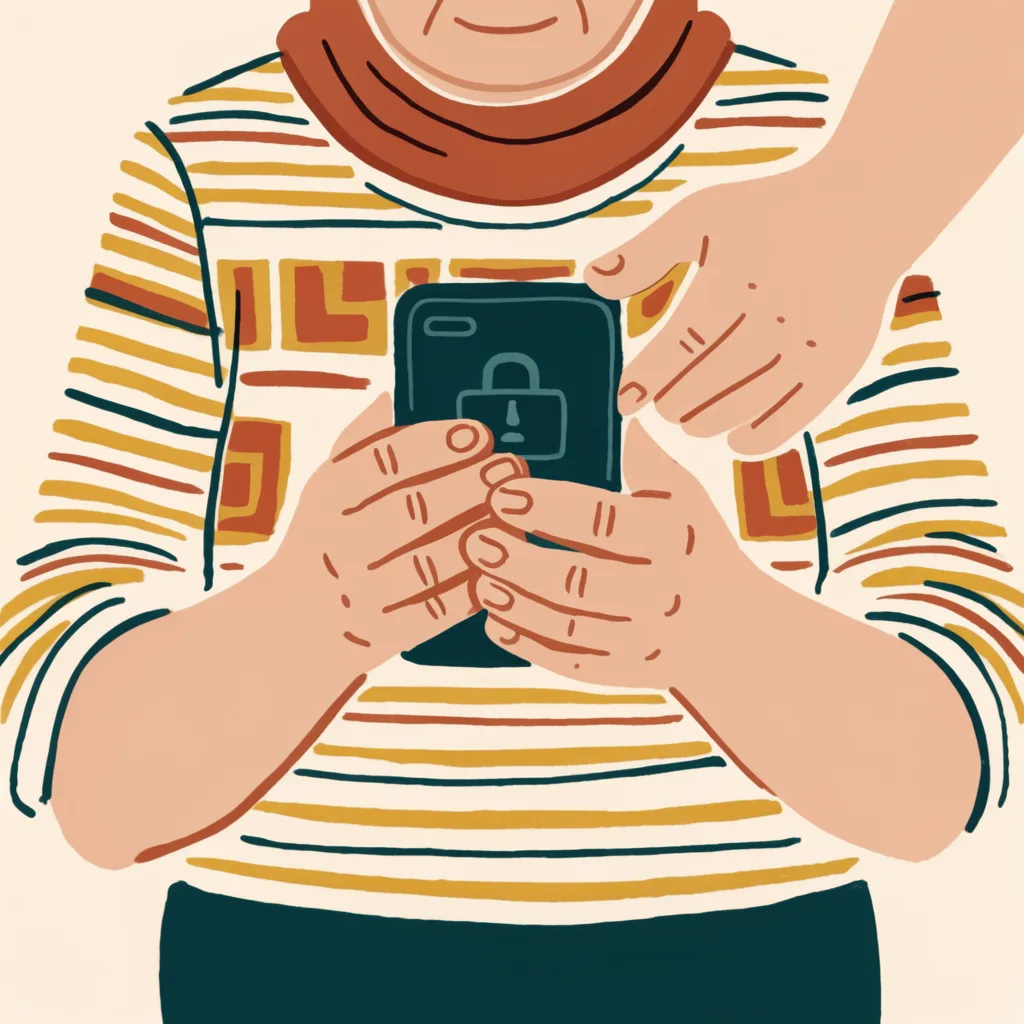
The Grandparent Scam: When "It's Me, Grandma" Isn't Grandma
The phone rings. It's your grandson, or a voice that sounds exactly like him: in jail, in the hospital, in trouble abroad, needing bail money wired right now, and please don't tell Mom and Dad. It's a staggeringly successful scam because it weaponizes the two things a grandparent can't ignore: love and urgency. Here's the anatomy, the three rules that stop it, and what to do if money already moved.
agree on the rules before the call
The grandparent scam defense map
The scam is a family emergency: fake crisis, fake grandchild, untraceable payment, plea for secrecy. Three pre-agreed rules stop it, and the first hour decides whether sent money can come back.
- Rule 1No safe word, no moneyEvery family gets a code phrase only close family knows. Anyone who cannot produce it gets zero dollars and a hang-up, even with a perfect AI voice clone.
- Rule 2Hang up, call the real numberNever call back the number that called or the "lawyer." Look up the grandchild's real number in the parent's own contacts and call it: the story collapses in one call.
- Rule 3Never pay by gift card, wire, or cryptoNo legitimate emergency is paid that way, ever. Bail, hospital, and legal bills go through real systems, not a grandparent with a wire transfer.
- If money movedThe first hour mattersContact the payment channel first (wire, gift-card issuer, payment app, bank), then report to the FTC and IC3, freeze credit, and watch for the fake "recovery" follow-up call.
The short version: the grandparent scam is a family-emergency scam: a fake crisis, a "grandchild" who can't talk long, a demand for untraceable payment, and a plea for secrecy. It works because real emergencies make people act before they think. The defense is three rules, agreed on before the call: (1) no safe word, no money: every family has a code word; (2) call the real number: hang up and dial the grandchild directly on a number you already have; (3) never pay by gift card, wire, or crypto: that payment method is the scam's fingerprint. If money already moved, act in the first hour: contact the payment company, the bank, and report to the FTC and IC3.
Not the page you need? This page is the full grandparent scam playbook: the script, the three rules, and the first hour after money moves. For the deep dive on the AI voice clone, when the caller sounds exactly like a family member, see the AI voice clone guide.
The script (it's the same every time)
The FTC's family-emergency scam guidance describes the pattern precisely. The call usually goes like this:
- "Grandma, it's me." Often with a name, sometimes an AI voice clone of the real grandchild. The caller-ID number may even appear to be the grandchild's (caller ID is spoofable; see verify-independently).
- A crisis with a deadline. I'm in jail, I hit someone's car / I'm in the hospital abroad / my wallet and phone were stolen and I need bail money now." The urgency is the point: there's no time to check.
- "Don't tell Mom and Dad." The secrecy request is the tell. It isolates the victim from the one person who would catch the lie in one phone call: you.
- A specific payment method. Wire transfer, gift cards (read the numbers over the phone), or cryptocurrency. All untraceable, all instant, all impossible to reverse.
- A "lawyer" or "police officer" takes over. A second caller confirms the story and adds authority. They'll stay on the line to keep the victim from checking.
It's designed to be finished in under an hour, before anyone verifies anything. The FTC reports these scams cost victims, overwhelmingly older adults, hundreds of millions of dollars a year, and the losses are growing as voice-cloning tools get cheaper.
Why it works on smart, loving parents
If your first reaction is "my parent would never fall for that," know this: the scam doesn't target gullible people. It targets people who love their grandchildren and would do anything for them in a real emergency. The emotional spike, fear for a child's safety, is exactly what shuts down the careful thinking that normally protects them. That's also why talking to your parent about scams in the abstract doesn't stop this one. The defense has to be concrete and pre-agreed: a safe word and a calling habit, not a lecture.
The three rules that stop it
- No safe word, no money. Set up a family safe word: a code phrase only close family knows. Rule: any family member in a real emergency will know it. Anyone who can't produce it gets zero dollars and a hang-up. This single rule defeats even perfect AI voice clones, because it's not about recognizing the voice: it's about a secret the scammer can't have.
- Hang up and call the real number. Don't call back the number that called you, and don't call the "lawyer." Look up the grandchild's real number from your own contacts and call it. If the story is true, the grandchild answers or someone at the real hospital/jail confirms it. If it's false, the whole house of cards collapses in one call.
- Never pay by gift card, wire, or crypto. No legitimate emergency (bail, hospital, legal) is paid with gift cards or crypto. Ever. If a caller insists on those methods, it's a scam by definition, no matter how real the voice sounds. (Bail in the US is paid through a court or bondsman, not through a grandparent with a wire transfer.)
Review these three rules with your parent, ideally during the same visit where you set up the safe word, and keep it to one page. The goal isn't to make them paranoid: it's to give them a reflex that works even mid-panic.
What to do if your parent already sent money
Time matters: the first hour is when recovery is possible. Move through these in order:
- Contact the payment channel first. If it was a wire (Western Union, MoneyGram), a gift card (the card issuer's fraud line), a payment app (Zelle, Cash App, Venmo), or a bank transfer: call them immediately and report the fraud. Some companies can stop or reverse transfers if you act fast. The scam-recovery playbook covers each channel in detail.
- Report to the FTC at reportfraud.ftc.gov: the report helps investigators connect patterns, even when the money is gone.
- Report the crime to IC3 (the FBI's Internet Crime Complaint Center) if fraud occurred: this is the channel law enforcement actually uses for these cases.
- Freeze what's left. Place a credit freeze (it's free at the three bureaus), and watch for follow-up "recovery" scams: scammers often call back posing as "fraud investigators" who can recover the money for a fee. That second call is another scam.
The conversation that prevents the next one
How you talk about it determines whether your parent hides the next call or brings it to you. The shame-free conversation matters as much as the security steps:
- Thank them for telling you. The moment they report it is the win, not the loss that preceded it.
- Never "how could you fall for that?" It teaches them to hide the next attempt, and the scammers know this. They count on shame doing their work for them.
- Turn it into one rule, not a lesson. "From now on: no safe word, no money, for anyone, no exceptions."
- Watch for the follow-up scam. Tell them explicitly: anyone who calls claiming they can recover the lost money for a fee is a scammer. Recovery is free, through the channels above, or it's not real.
And if your parent is showing memory changes or a sudden wave of scam vulnerability, treat it as information worth sharing with their clinician: it's often one of the first observable changes, and it's one you can act on without any diagnosis.
Related guides
- Set up a family safe word: the one defense that beats voice clones
- Your parent sent money to a scammer. Now what? The first-hour playbook for every payment channel
- Verify any message through a channel you look up yourself: the universal rule this page builds on
- Impersonation scams: the other costumes: bank, utility, tech-support, government
- Run the Scam Risk Check: paste a suspicious message before acting on it; nothing is uploaded
Sources & verification
This page is checked against the standards in our editorial policy, preferring government sources for scam patterns. Reviewed August 2026:
- FTC: Scammers Use Fake Emergencies to Steal Your Money (retrieved August 2026)
- FTC: How To Avoid a Scam (retrieved August 2026)
- FBI Internet Crime Complaint Center: IC3 (retrieved August 2026)
Found an error? Report it: we log and correct material mistakes publicly.