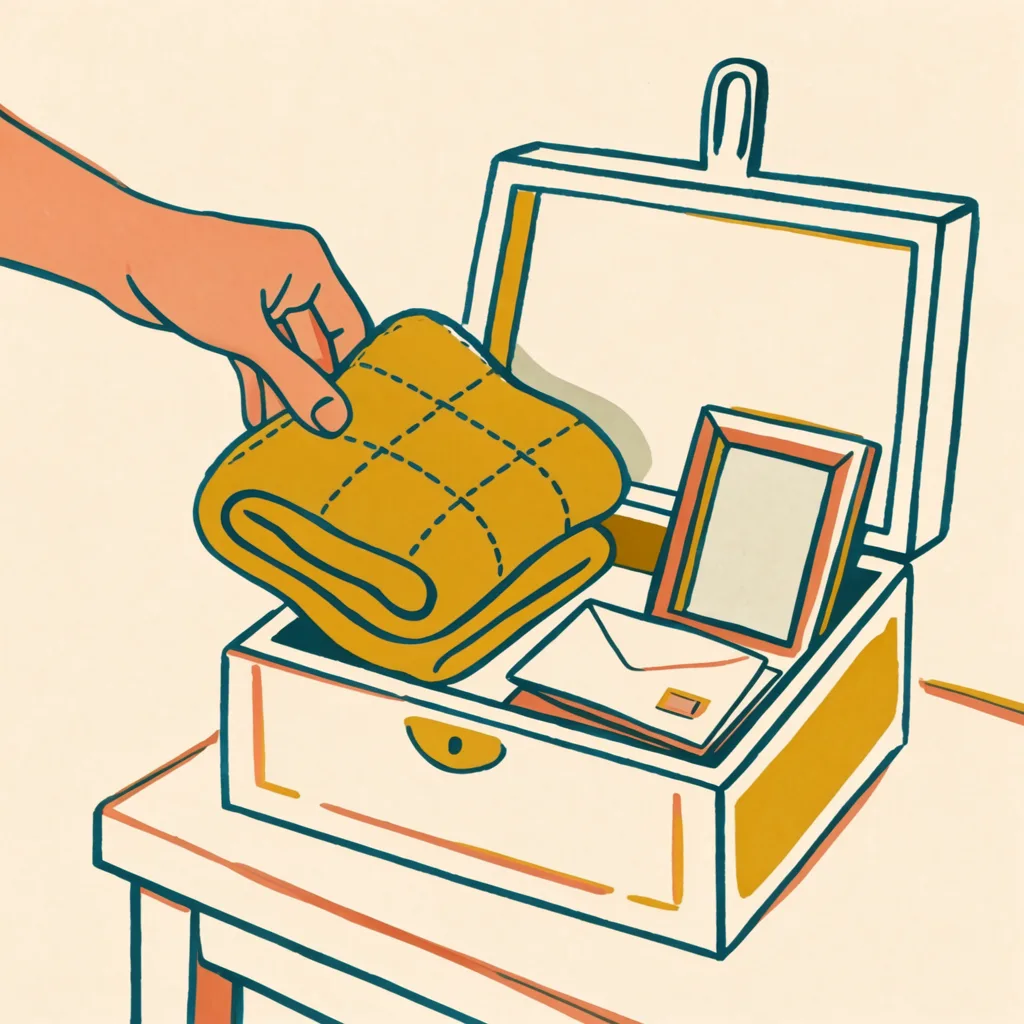
The Keepsakes: How to Decide What Stays When a Parent Downsizes
The china, the photo boxes, the high school sweater, the good silver that never gets used. Sentimental stuff is where downsizing actually goes to die: every other decision is easy compared to this one. This page is the missing decision method: how to keep the meaning without keeping everything, and how to share what matters between siblings without a fight.
keep the story, not the object
The keepsake decision map
You are not deciding whether an object matters; you are deciding whether the meaning needs the object or just the story. Three questions do most of the work, and the photo trick keeps the memory.
- Q1Does it have a story only it can tell?Not "I like it" and not "it was Grandma's": does this specific object carry a memory no photo and no sentence could replace? The hand-sewn wedding dress: yes. The fourth set of mixing bowls: no.
- Q2Would it earn a place in your home today?Not someday, not when the house is bigger: today. If you would not display, use, or hang it this year, it is not a keepsake; it is an obligation with a box.
- Q3Would the giver want you to store it?Almost nobody gives a gift hoping it will sit in a plastic bin for thirty years. Most would be delighted it was photographed, remembered, and passed to someone who would use it.
- The photo trickKeep the story, lose the boxPhotograph the item where it lives, write the story in one or two sentences ("Aunt Rosa's silver tray, every Thanksgiving 1974-2005"), and put both in the shared album. Once the story is captured, most objects stop being precious.
The rule, in one sentence: you are not deciding whether an object matters. You are deciding whether the meaning needs the object, or just the story. The story can be kept in a photo and a sentence; the object is the expensive version.
Why sentimental stuff is the bottleneck
Every good downsizing guide (including ours) says the same thing: protect the sentimental items first, decide them last. That advice works, and it also hides the real problem: nobody ever explains how to decide. So the sentimental boxes sit in the garage, the move happens around them, and ten years later they are still unopened.
The other thing nobody says out loud: sentimental items are where the family fights live. Not over the furniture, and not over the appliances. Over the one item that means something to two different people in two different ways. The method below is designed to make those decisions faster and less personal, because speed and detachment are the only things that actually help.
The three questions that do most of the work
For each item, ask these in order. Stop at the first yes.
- Does it have a story only it can tell? Not "I like it" and not "it was Grandma's," but: does this specific object carry a memory that no photo and no sentence could replace? The wedding dress your mother sewed by hand in 1962: yes, that's a story. The fourth set of mixing bowls: no.
- Would it earn a place in your own home, today, on its own? Not "someday," not "when we have a bigger house." Today. If you would not display it, use it, or hang it this year, it is not a keepsake; it is an obligation with a box.
- Would the person who gave it want you to store it? Almost nobody gives a gift hoping it will be carried between three apartments in a plastic bin for thirty years. Most people would be delighted to know it was photographed, remembered, and passed along to someone who would use it.
If the answer to all three is no, the item is not sentimental. It is clutter wearing a costume, and it goes through the normal sort in What to Do With All the Stuff.
The photo trick: keep the story, not the object
This is the single most useful technique in the whole downsizing playbook, and almost nobody knows it:
- Photograph the item where it lives, with the person who loves it. A phone photo is fine.
- Write the story in one or two sentences: who gave it, what it was for, why it mattered. "Aunt Rosa's silver tray, used every Thanksgiving from 1974 to 2005."
- Put the photo and the sentence together in a shared family album (a simple shared folder works) with the year.
- Now the object can go to a new home, or to donation, without the meaning going with it. The memory survives in a form you will actually look at.
Families that do this report the same surprise: once the story is captured, most objects stop being precious. The fight was never about the tray. It was about the fear of forgetting Aunt Rosa. The photo ends that fear.
Photos themselves: the biggest sentimental category
Shoeboxes of prints are the most common sentimental item of all, and they are the easiest to solve, because the meaning is in the image, not the paper.
- Do not sort the shoeboxes one photo at a time. That takes forever and everyone quits. Sort by decade or by person, and keep only the images that are sharp, in focus, and show a face or a place you recognize.
- Digitize in batches. A flatbed scanner or a phone scanning app handles several photos at once. One rainy afternoon covers a shoebox.
- Keep the physical copies that are truly special: the wedding album, the military photos, the one picture of the house they grew up in. Let the rest live as digital files.
- Back up the digital files twice: one copy on the parent's device or a drive, one copy in the cloud or with a sibling. Digital files that exist in exactly one place are not backed up; they are waiting to be lost.
And the framed photo on the wall: that is not a keepsake, that is decor, and it moves with them. Keepsakes are the boxed stuff nobody looked at in a decade.
How to share the keepsakes between siblings
This is where families bruise. The method that works:
- Pick, don't argue. Each sibling takes turns choosing one item, oldest to youngest or youngest to oldest, until the sentimental pile is empty. Turns remove the auction dynamic where whoever argues loudest wins.
- Set a limit per person before you start. "Everyone gets five keepsakes." The limit is what makes the turns work; without it, the first turn takes an hour.
- If two people want the same thing, neither of them gets to decide by fighting. Options: one takes it now and the other gets first pick of the next round; or it goes in the "rotate" box, passed between households on birthdays; or one keeps it and the other gets a high-quality photo with the story (the photo trick again).
- The parent should not be in the room for this. Sibling division is between siblings. The parent's job was deciding what leaves the house, not which child "deserves" the locket.
If sibling tension is running hot already, Siblings Fighting Over Parent Care has the wider playbook, and how siblings can divide recurring parent tasks covers the fairness frame that applies here too.
What to actually say to the parent
Sentimental sorting is emotional for the person whose whole life is in the room. The wrong move is to push; the right move is to give them the control and the time:
- "Nothing leaves this week." Remove the deadline from the conversation entirely. The decision becomes easier once it is not a countdown.
- "What's the story behind this one?" Let them tell it. The telling is often the letting-go: once the story is out loud, the object has done its job.
- "Which of these would you want me to remember you by?" This reframes the choice from loss to legacy. Parents are almost always clearer when the question is about what the children should carry forward.
- Never say "this is just stuff." To them it is not. The method above gives you a way to respect that and still make progress; invalidating it just locks the doors.
The keepsake box rule
At the end of a downsizing, everything sentimental that survived the three questions should fit in one clearly labeled box per person, or one drawer. That is not a random standard: a box you can lift and carry is a box that will actually be kept. If the keepsakes cannot fit in one box, the three questions were not asked honestly, and it is worth another pass. See How to Start Downsizing a Parent's House for the session structure, and When a Parent Won't Let Go of Their Stuff for the harder emotional cases.
Related
- How to start downsizing before a crisis: the five-box system and the session structure.
- What to do with all the stuff: the four piles, including what happens after the keepsakes are pulled out.
- Helping parents move to a smaller place: the full move, including what earns a place in the new home.
- When a parent won't let go: the deeper emotional resistance, and when to involve a professional.
Sources
- NIA: Getting Started as a Caregiver (retrieved August 2026)
- NIA: Sharing Caregiving Responsibilities (retrieved August 2026)
- FTC: What to Know About Identity Theft (retrieved August 2026; for the paperwork in the same boxes)
Found an error? Report it.